Posts

Showing posts with the label Glasgow

December Weather Patterns
Image
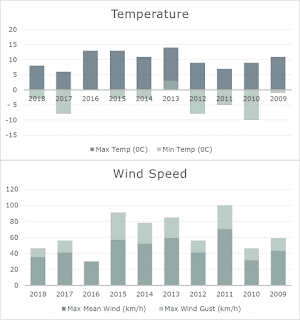
Do you remember the weather last December? Some of it wasn't pretty, such as Storm Deirdre.  In case you have forgotten, the Met Office's report states the following impact: Freezing rain caused treacherous conditions and multiple traffic accidents, particularly on the M74 and across southern Scotland, and the A66 across the North Pennines was closed. There were further traffic incidents across parts of England and Wales, reports of fallen trees and several hundred homes without power across parts of Wales and Scotland. Planes had to abort landings at Manchester Airport due to strong crosswinds. And here are some contemporary reports: https://www.theguardian.com/uk-news/2018/dec/15/storm-deirdre-batters-britain-snow-freezing-rain https://www.bbc.co.uk/news/uk-scotland-46574942 https://www.theguardian.com/uk-news/2018/dec/16/storm-deirdre-set-to-ease-after-snow-and-gales-wreak-havoc In short, not a great few days to be out and about. Was this a one off or more typical...

The Clyde Fastlink - A Follow Up

Image
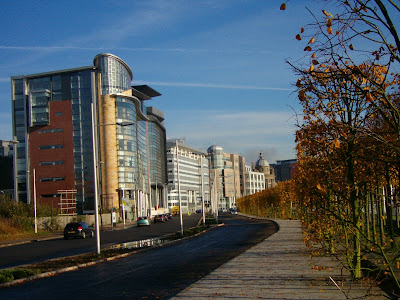
In the three years and three weeks since EcoWarriorMe's first post on Glasgow's Fastlink priority bus route there has been a whirlwind of inactivity, culminating in a buses  running along the dedicated lane along the Broomielaw for a few weeks this summer as the new Southern General hospital opened its doors. Then stopped while some modifications were made. Then back again. And now, according to BBC Scotland: Bus firms ditch 'too slow' £40m fast lanes in Glasgow 4 hours ago   From the section Glasgow & West Scotland Image copyright Google Image caption McGill's is one of two operators to withdraw from using the Fastlink lanes Two major bus firms have stopped using the newly-built  £40m Fastlink lanes in Glasgow  because they are too slow. On the positive side, bus shelters have been added to the route in the last few weeks so you can stand out of the rain waiting for the bus that will never come (surely such facilities should be an integral ...

Clyde Fastlink - A Revolution in Public Transport

Image
The problems with delivery of Edinburgh's new tram system has been well reported in the media, mostly because of the disruption caused by the works, its immense price tag and lengthy delays but Glasgow's bold new transport initiative has grabbed a lot less headlines, probably because of its more modest price tag and, more likely, due to its spectacular lack of impact on the city.

Here Comes the Rain - Part 2

Image
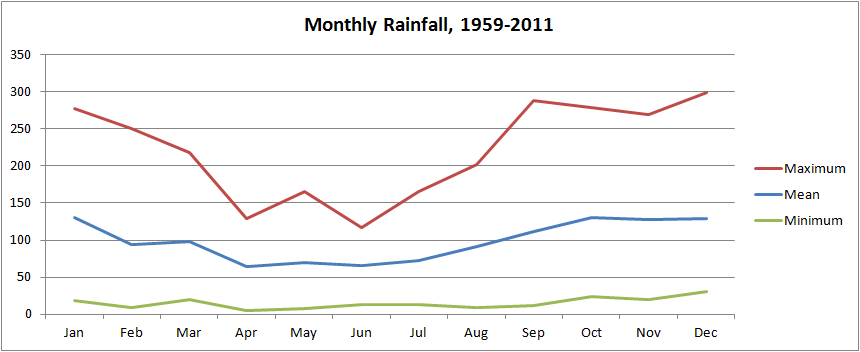
It is official. Britain has had the wettest summer since 1912 according to the Meteorological Office . This follows one of the wettest springs on record. Is this evidence of climate change or simply natural variation in the weather? To try answering this question, data from a weather station near Glasgow has been analysed . The first part of this article presented annual rainfall records and concluded that there has been only a slight increase in annual rainfall over the past decade compared with a baseline of 1961 to 1990 but that there had been a marked increase in variability. Also of interest is whether rainfall patterns have changed throughout the year, from month to month and between the seasons which is the subject of this post. In order to provide some context, June 2012 was the wettest recorded June in 54 years with 130mm of rainfall which is almost double(196%) the average rainfall for the month and July is the fourth wettest with 75% more than average. Apart from this year...

Here Comes the Rain - Part 1

Image
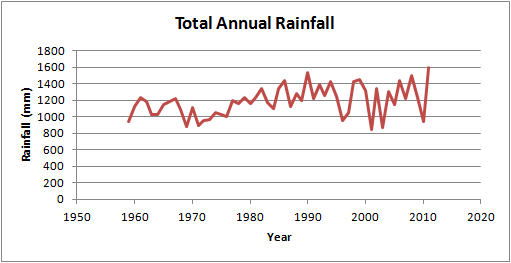
Summer 2012 may be remembered for the Olympic Games. Or it may be remembered for the rain. From doom laden predictions of the worst drought for a generation in the southern half of Britain with disastrous consequences for farmers in the spring to torrential rain, floods and, yes, disastrous consequences for farmers in the summer. The burning question is whether this is just the natural variability of weather or whether underlying climate change has a hand in driving these weather systems. To investigate this question, I have studied some local weather records. My statistical skills are about High School level: mean and standard deviation of a normal distribution. Data for Glasgow Airport from 1959 to 2012 was obtained from the  Meteorological Office website but the 2012 data was discarded as it is only provisional and represents an incomplete year. The data included monthly rainfall, sunshine and maximum and minimum temperatures and the focus of this study was the rainfall data. ...

Electric Cars

Image
Glasgow is a compact city.  Nowhere in the city is much further than 10 miles from any where else.  It is perfect for electric vehicles(EVs) which typically have a short range. Pictured above are two of the forty electric vehicles being trialled by Glasgow City Council.  The trial which began over a year ago is scheduled to run for three years.  The vehicle fleet operated by the City Council comprises over 1200 vehicles of which over 350 are cars or car derived vans with the remainder including everything from small vans to bin lorries, minibuses and even articulated lorries. This is surely a welcome measure to reduce the city's carbon footprint and improve air quality. Or is it?

The Broomielaw

Image
The Broomielaw and the Tradeston Footbridge A long time ago, spring 2009 to be precise, Stephen Purcell, the leader of Glasgow City Council formally opened the Tradeston footbridge over the River Clyde from the Broomielaw on the North bank to Tradeston.  The new bridge formed the focus of a £33 million regeneration scheme for the area which involved strengthening existing quays walls to create an attractive public space. But not for long. At the opening Purcell said: “The Tradeston Bridge and the wider scheme to develop new public places will act as a catalyst for future regeneration of the Tradeston area.  It is important that the public purse continues to invest in the city’s infrastructure at this difficult time to bolster Glasgow’s economy and pave the way for future development along the Clyde waterfront.” This is where the conflict seems to come in: creating public spaces and bolstering the economy no longer appear compatible.

Why can't we recycle more?

Image
I began writing this a couple of weeks ago, about Glasgow City Council's inability to implement a half decent recycling scheme but didn't quite get around to finishing and posting it.  Since then, there have been signs of improvement, which I'll come on to after outlining the situation in the recent past. HISTORICAL SITUATION Glasgow likes to think of itself as the ‘Dear Green Place’ but it is unfortunately far from Green. Although the city is being promoted as a hub for renewable energy with both Scottish Power and Scottish & Southern Energy locating their renewable energy divisions in the city, the city recycles less than 16% of domestic waste. An assessment of the UKs twenty largest cities,shown below, ranked Glasgow as the 19th most sustainable city overall and 20th in terms of recycling, it doesn’t take a genius to work out that is last place.  With the UK being one of the poorest nations in Europe at recycling, the comparison is grim.