Posts

Showing posts with the label Energy & Climate Change

Biofuel Status 2026

Image
  Fifteen Years On: Are Biofuels Delivering on the IEA’s 2011 Vision? In April 2011, the International Energy Agency (IEA) published an ambitious roadmap claiming that biofuels could supply 27% of global transport fuel by 2050 , up from around 2% at the time ( EcoWarriorMe: Biofuels (2011) ). The roadmap argued that sustainable biofuels would become essential for reducing emissions from aviation, shipping and heavy transport while improving energy security. Now, fifteen years later, we are almost half way towards the forecast horizon and the transport and energy landscape looks very different. Electric vehicles have advanced far faster than many analysts expected, while biofuels have evolved into a more specialised — but still strategically important — decarbonisation tool. The 2011 Roadmap  The original roadmap envisioned: Biofuels rising from 2% to 27% of global transport fuel by 2050. A major shift from food-crop biofuels to “ advanced biofuels ” made from waste, re...

The Carmont Train Crash

Image
What it means for Infrastructure Climate Resilience Six years ago, on the morning of 12 August 2020, a ScotRail passenger train derailed near Carmont, south of Stonehaven in Aberdeenshire. The derailment was caused by the train striking debris washed onto the track following an intense rain storm. The accident claimed three lives, injured six others and became the deadliest railway accident in Britain for almost two decades. Yet the tragedy was more than an isolated engineering failure. The investigation conducted by the independent Rail Accident Investigation Branch (RAIB) concluded that it exposed wider weaknesses in the way Britain's railway understood and managed the risks posed by increasingly severe weather[1]. As climate change alters rainfall patterns and increases the potential for more frequent episodes of intense rainfall, Carmont has become a defining case study in the importance of building climate resilience into ageing infrastructure. Before considering the technical...

Quietly does it...

Just quietly slipping into your feed again after a short break. No fanfare. No big announcements. No grand plans. Just this, after an extended hiatus, followed by a planned "grand" return that fizzled out before beginning.  It's just like another corporation quietly dropping their net zero ambitions, expecting nobody to notice.  Why now? If you haven't been living under a rock the last few months (and I'd be slightly envious if you have) you will be well aware of the climate related news.  We have seen tumbling temperature records already this summer. Highest May and June temperatures in the UK, record temperatures across much of Europe and parts of North America.  Events for the US semiquincentennial celebrations were cancelled in DC due to extreme heat and New York City had established cooling centres for vulnerable people. The UK has had three heatwaves already by mid-July. Wildfires are widespread with multiple fatalities in Spain and hundreds of thousands eva...

Can't see the Wood from the Trees (because the forest is burning)

Whether royalist or republican, we must applaud Prince Charles for using his power and influence to highlight the great problem of deforestation and its link to climate change as well as loss of biodiversity. http://www.theguardian.com/environment/2015/dec/01/no-plan-b-for-climate-change-without-forests-prince-charles-tells-paris-summit http://www.bbc.co.uk/news/science-environment-34973166 But we should we be taking advice from him? If we all took our lead from Charles, we would be sure to hit a four degree temperature rise by the early 2030s[1]. Alternatively if we mirrored land use in his personal estate, the Duchy of Cornwall, we would lose 90% of our forests, since the Duchy is only 3% forested compared to 31% of the world's land surface. And if we were each granted an estate similar to Charles, all of the usable land surface would be gone after the first 120,000[2] people and the rest would have nowhere to go! No matter how extravagant the lifestyle, a global popula...

400

Image
We humans like round numbers.  We don't celebrate the 23rd annual summer fete or the 49th anniversary of an organisation but the 25th or 50th respectively. This is why the quantity of carbon dioxide in the atmosphere has hit the headlines this week. The daily measurement at Mauna Loa on Hawaii has passed 400 ppm (parts per million) for the first time. Not so much a cause for celebration; more a cause for commiseration  The actual measurement was 400.03 but was subsequently revised down to 399.89 (but what is fourteen hundredths of a part per million between friends). Breaching this threshold was not particularly unexpected but it is symbolic in human terms; it is a memorable number. But what are the implications of exceeding a CO2 concentration of 400 ppm? Some climate change skeptics will be quick to highlight the scientific evidence that shows the atmospheric CO2 has been at this level and higher on the past. They are absolutely correct. Somewhere in the ...

The 100th Post - A Retrospective

On noticing that this would be EcoWarriorMe's 100th post, I thought it would be a good opportunity to review what we set out to do and how the blog has developed over the past two years and to highlight some of the most popular posts and personal favourites. The blog was born of a frustration at the general apathy and lack of progress towards a more sustainable society including climate change, pollution, wasteful squandering of precious resources and the relentless despoiling of our natural environment.  I aimed to highlight things that we can do to reduce our negative impact and demystify some of the competing arguments for and against particular courses of action.  I knew that I didn't have all of the answers and I still don't. I don't even know all the questions although I'm working on that. I enjoy learning and am interested in the science and engineering on which our modern society is based but I expected to probe a bit deeper rather then taking things at fa...

Energy from Waste

We must find alternatives to fossil fuels for our energy. We must also tackle the huge amount of waste we send to landfill. Waste that is packed with energy. An obvious solution would be to extract energy from the waste but it is never that simple.  Energy can be extracted using different technologies such as anaerobic digestion used in some material recovery facilities or direct combustion (incineration) of the waste. EcoWarriorMe has previously commented  on anaerobic digestion which produces methane gas that can be burned to produce heat, generate electricity or, in the case of CHP, both. The main criticism of this technology is that it generates demand for waste, particularly organic waste such as food. Incineration is probably the most controversial of the technologies due to the toxins which can be emitted from the plant.  In the 1980s, controversy surrounded the waste incineration plant at Bonnybridge near Falkirk which was blamed for illness in livestock w...

Martyr or Mug

It’s early. 5:45 AM to be precise. I have a large paper cup of coffee in front of me with one of those dastardly plastic lids. The ones that jettison steaming hot coffee up your sleeve when you walk. Looking to my left, out of the window, I see the lights of the still sleeping city rumble by. Full of people snuggled up in bed, still in their own personal dreamland: dreaming of past glories and future ambitions, subconsciously sifting through the meaning of life. I should be there too. Now I look forward. I see a long and wearisome day ahead. Two days ago, my presence was requested, nay, demanded, at a meeting in London later this morning. Other commitments yesterday and tomorrow mean that I must travel there and back again in a day so I’m on the day’s first Virgin train service out of Glasgow. I hope to arrive 400 miles away in London in four and a half hours. I thought long and hard about how to travel. Whether to go for the speed of flying versus the slower but greener train, eve...

The Changing Seasons

There was a nip in the air this weekend as the season begins to change and, if we needed it, a timely article in this Sunday's Independent serves as a reminder of some of the things we can do to save energy over the autumn and winter. The ten suggestions from the Independent are summarised below with some comments and a few other suggestions of my own: 1. Small changes - with emphasis on energy saving lightbulbs: Incandescent light bulbs are no longer available for domestic use so we should all be using low energy bulbs now or in the near future. 2. Efficient heating - ensure your radiators are working effectively and aren't blocked by furniture. Upgrading your boiler is also suggested but this can be a significant financial investment. The savings from upgrading your boiler depend on how inefficient the old one was and there may be other more cost effective energy saving investments. 3. Keep the heat in - draught proofing, loft insulation, cavity wa...

Here Comes the Rain - Part 2

Image
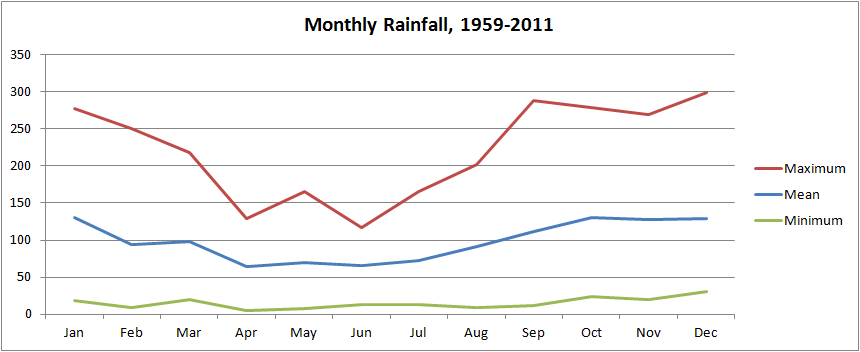
It is official. Britain has had the wettest summer since 1912 according to the Meteorological Office . This follows one of the wettest springs on record. Is this evidence of climate change or simply natural variation in the weather? To try answering this question, data from a weather station near Glasgow has been analysed . The first part of this article presented annual rainfall records and concluded that there has been only a slight increase in annual rainfall over the past decade compared with a baseline of 1961 to 1990 but that there had been a marked increase in variability. Also of interest is whether rainfall patterns have changed throughout the year, from month to month and between the seasons which is the subject of this post. In order to provide some context, June 2012 was the wettest recorded June in 54 years with 130mm of rainfall which is almost double(196%) the average rainfall for the month and July is the fourth wettest with 75% more than average. Apart from this year...

Here Comes the Rain - Part 1

Image
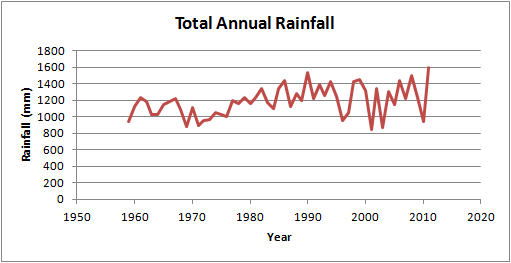
Summer 2012 may be remembered for the Olympic Games. Or it may be remembered for the rain. From doom laden predictions of the worst drought for a generation in the southern half of Britain with disastrous consequences for farmers in the spring to torrential rain, floods and, yes, disastrous consequences for farmers in the summer. The burning question is whether this is just the natural variability of weather or whether underlying climate change has a hand in driving these weather systems. To investigate this question, I have studied some local weather records. My statistical skills are about High School level: mean and standard deviation of a normal distribution. Data for Glasgow Airport from 1959 to 2012 was obtained from the  Meteorological Office website but the 2012 data was discarded as it is only provisional and represents an incomplete year. The data included monthly rainfall, sunshine and maximum and minimum temperatures and the focus of this study was the rainfall data. ...

Tell Shell

Image
Tell Shell that you don't want them drilling for oil in the Arctic. It is one of the least spoiled places on earth but Shell want to explore for oil. Climate change is more rapid in the Arctic than almost any where else on the planet, leading to greater areas of the Arctic Ocean being ice free than ever before in the history of oil exploration. This makes oil exploration easier, an opportunity that Shell are keen to exploit. But picture this: if a leak or spill occurs as the ocean begins to freeze over for the winter, there are no tools or methods available to contain and recover the oil. Floating booms won't work. Detergents won't work (and can cause damage themselves). The oil will be locked in the ice, travelling around the ocean until it melts next year, depositing a filthy slick

Another Landslide

Another  landslide closes the A83 Rest and Be Thankful with the road expected to remain closed until at least Friday.  This time debris has not landed on the road but the remote monitoring system triggered an emergency closure. This landslip occurred after nearby Tyndrum recorded 54mm (2") of rain in 24 hours. Also announced today is a project to remove a bottleneck on the A82, which is the main route from Glasgow to the west highlands and the diversionary route when the A83 is closed. Related post: Rest and be Thankful, but not about Climate Change

Wind Energy Costs

Image
Following the recent attack on wind farms by MPS, I wanted to look at the cost of wind energy in fairly broad terms.  The latest attack on wind farm development is by a list of over 100 hundred Members of Parliament from across the political spectrum (I counted 2 Labour, 2 Lib-dems, one DUP, with the remainder being conservative) who wrote an open letter to the Prime Minister calling for a ban on any subsidies and tightening planning controls to make it easier for people to block developments. This coming from a government that wants to reform planning to include "presumption in favour of sustainable development".  They appear to rate wind farms as unsustainable while new housing on greenbelt is perfectly sustainable; we have so much green space that we can build on it now without limiting future generations ability to build on it too!

Wind farms blight the Landscape

Image
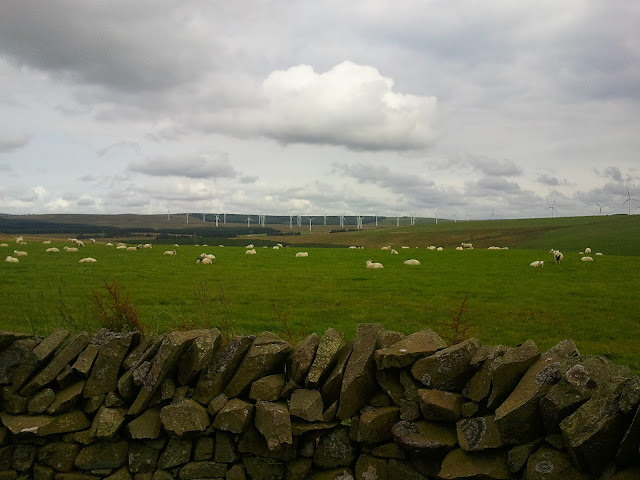
Are wind farms a blot on the landscape? What are those white things over there? Oh, they're sheep.

New Nuclear for Somerset

Earlier this week EdF Energy announced the preferred bidder for the £100 million contract for site preparation works at one of the first sites for a new nuclear power station: Hinkley Point C in Somerset. The work is subject to satisfying planning conditions but includes site preparation, excavation and installation of construction site infrastructure to allow main construction to begin. They also announced an agreement with AREVA in relation to the early design work for the main reactor systems, which will allow AREVA to begin the work in January. The following day they welcomed decisions by the Office of Nuclear Regulation (ONR) to issue an Interim Design Acceptance Confirmation, and the Environment Agency to issue an Interim Statement of Design Acceptability, for the EPR Pressurised Water Reactor. This is the same basic reactor design that has proven problematic at Flamanville in France.The new reactor at Flamanville is estimated to be about 4 years late and almost double the o...

Rest and be Thankful, but not about Climate Change

Image
At seven o'clock this morning around 100 tonnes of debris fell on to the A83 near the Rest and be Thankful in Argyll.  The alternative route is between 30 and 50 miles longer depending on how much you need to double back at either end.  Similar landslips have happened on the A83 before but only recently, in 2007 , 2009 and now in 2011 , all preceded by periods of prolonged heavy rain.

Energy Market Reform

There has been a lot of discussion recently about rising domestic energy prices and competition failures in the market, most recently the figures published by Ofgem on the profit made per customer by the big six energy suppliers. While these snapshot figures may not be particularly helpful in telling the whole story, they certainly reveal enough to raise the issue to the top of the agenda. The market is poorly functioning and there is too much complexity, lengthy tie-ins on the best deals and better deals for new customers.  This is an inevitable consequence of different suppliers selling essentially an identical product, with price being the only comparison.  The lights aren't brighter with electricity from one supplier compared with another, only cheaper or dearer.

Weekly Refuse Collections

Despite the austerity measures we currently face, the government has miraculously found £250 million to encourage local authorities to reinstate weekly refuse collections in England. There is, apparently, a huge public outcry about the change to fortnightly collections. Certain parts of the press have been stirring up scare stories about rubbish piling up on our streets for weeks, giving off bad smells and attracting vermin. Not only is a concern, it is also an election issue according to the Daily Mail. Many years ago, our council changed from twice weekly collections to weekly collections and similar stories were spun but were never realised. At that time the bins were changed from small metal bins that the bin men carried to the truck and emptied to larger bins with single use removable liners, starting a trend of producing plastic bags with a single use-putting it in the bin. I don't know the details of individual fortnightly bin collections around England, but the new f...

The War Effort

Image
In a recent post to the renewable-energy Yahoo group, a post compared the production of aircraft during World War II with the manufacture of wind turbines in order to achieve 100% renewable energy in the US.  It is a fitting comparison since the threat from global warming is every bit as serious a threat to our way of life as Hitler was.  If only it was as visible as a line of tanks crushing everything before them as they trundled through Europe then the powers that be would be motivated to take action rather than talk around the issue.  The same media that denies global warming would support measures to tackle it for fear of being unpatriotic and thus motivate mass participation in carbon reduction programmes. Back to the original quote: