Posts

Showing posts with the label transport

Getting Back in the Saddle, Part 1
Image
After last week's post , I would like to say how easy it was for me to get back in the saddle but it wasn’t. It was hard.  I don't want to be misleading. Like breaking most habits it required effort, a bloody minded determination to gain traction. That and a plan. This wasn't my first attempt at cycle commuting. In last week’s post, I mentioned the time I did cycle to work but was put off repeating it by a combination of my physical condition, the riding conditions and doom-laden predictions from my colleagues. On a few other occasions I have tried with slightly better success, but still not enough to fully make the transition to cycling as my main mode of transport. Previous plans involved breaking myself in gently, cycling once a week for a few weeks then steadily increasing the frequency as I got fitter and more used to the traffic. Three weeks in a row was my record, cycling to work on two days in the last week. It wasn't frequently enough to build fitness or, more ...
How I fell off my bike

Image
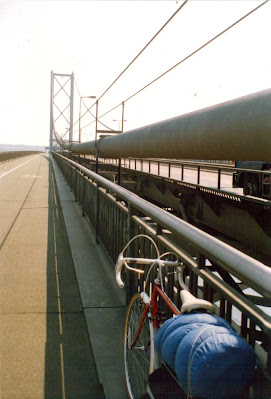
Not literally, but how I got out of the habit of cycling.  This is the first of a series of three posts on my personal journey away from regular cycling then back into it over many years.  This post talks of how I used my bike to get around and some of the barriers to me getting back into it. In the next post I will talk about how I got back into it, in a manner, and the final post brings us up to date.  This is only my perspective but I'm sure it is not unique and you may have similar experiences. It happens to so many of us, that we regularly cycle as children and adolescents then “grow” out of it as adults.  Until I left school I cycled everywhere: to school, to the shops, to my Saturday job, to the swimming baths and any other activities that were farther than a five minute walk.  During the holidays I would make 30 mile (50km) round trips to visit my grandparents or 70 mile (110km) round trips to the beach and, a couple of times, longer trips over several d...

The Clyde Fastlink - A Follow Up

Image
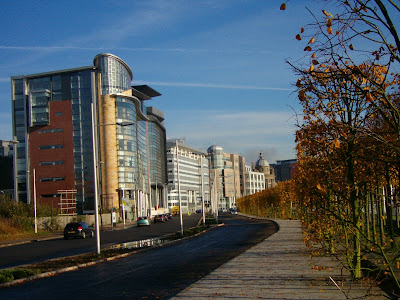
In the three years and three weeks since EcoWarriorMe's first post on Glasgow's Fastlink priority bus route there has been a whirlwind of inactivity, culminating in a buses  running along the dedicated lane along the Broomielaw for a few weeks this summer as the new Southern General hospital opened its doors. Then stopped while some modifications were made. Then back again. And now, according to BBC Scotland: Bus firms ditch 'too slow' £40m fast lanes in Glasgow 4 hours ago   From the section Glasgow & West Scotland Image copyright Google Image caption McGill's is one of two operators to withdraw from using the Fastlink lanes Two major bus firms have stopped using the newly-built  £40m Fastlink lanes in Glasgow  because they are too slow. On the positive side, bus shelters have been added to the route in the last few weeks so you can stand out of the rain waiting for the bus that will never come (surely such facilities should be an integral ...

Testing Times

Image
What is the point of exams? Is it to test the candidate's knowledge of the subject or is it to test the candidate's skill in passing exams? In theory at least, it should be the former but when there is a lot riding on the result there is a tendency towards the latter with students placing more emphasis on training to pass the exam rather than gaining a deep understanding of the subject. The student may gain some knowledge of the subject, but only those parts that will gain most marks in the exam as part of a strategy to maximise the result for minimum effort. This doesn't only apply to academic exams.  Similar strategies can also be adopted for all sorts of tests.  For example, if a car maker wants their car to get a good fuel efficiency rating they can work on scoring better in the test, rather than improving the car's performance.  They can use non-standard high performance lubricants, disconnect the alternator, over inflate the tyres, remove door mirrors and ...

The 100th Post - A Retrospective

On noticing that this would be EcoWarriorMe's 100th post, I thought it would be a good opportunity to review what we set out to do and how the blog has developed over the past two years and to highlight some of the most popular posts and personal favourites. The blog was born of a frustration at the general apathy and lack of progress towards a more sustainable society including climate change, pollution, wasteful squandering of precious resources and the relentless despoiling of our natural environment.  I aimed to highlight things that we can do to reduce our negative impact and demystify some of the competing arguments for and against particular courses of action.  I knew that I didn't have all of the answers and I still don't. I don't even know all the questions although I'm working on that. I enjoy learning and am interested in the science and engineering on which our modern society is based but I expected to probe a bit deeper rather then taking things at fa...

Clyde Fastlink - A Revolution in Public Transport

Image
The problems with delivery of Edinburgh's new tram system has been well reported in the media, mostly because of the disruption caused by the works, its immense price tag and lengthy delays but Glasgow's bold new transport initiative has grabbed a lot less headlines, probably because of its more modest price tag and, more likely, due to its spectacular lack of impact on the city.

BMW Attacks Efficiency Targets

BMW accused of hypocrisy over opposition to European car targets | Environment | guardian.co.uk : BMW  is lobbying to water down European plans to improve the fuel efficiency of cars at the same time as trumpeting its green credentials as the  official car sponsor of the Olympic Games , according to internal documents seen by the Guardian. According to this Guardian article, BMW want to delay or reduce implementation of Europe wide fuel efficiency targets for 2015 and 2020.  BMW believe that premium  manufacturers (such as themselves) will be disadvantaged compared with manufacturers of normal cars. In other words people who can afford more expensive premium cars can afford the higher fuel prices and these wealthy people don't need to worry about climate change or limited supplies of oil.

Electric Cars

Image
Glasgow is a compact city.  Nowhere in the city is much further than 10 miles from any where else.  It is perfect for electric vehicles(EVs) which typically have a short range. Pictured above are two of the forty electric vehicles being trialled by Glasgow City Council.  The trial which began over a year ago is scheduled to run for three years.  The vehicle fleet operated by the City Council comprises over 1200 vehicles of which over 350 are cars or car derived vans with the remainder including everything from small vans to bin lorries, minibuses and even articulated lorries. This is surely a welcome measure to reduce the city's carbon footprint and improve air quality. Or is it?

News Round up - 31st May

After a relaxing weekend by the seaside, away from television and internet, I have returned to find a busy News weekend and here is a round up of the stories catching my attention: BBC News - Global carbon emissions reach record, says IEA  - disappointing, but if the global economy is to grow using the established economic models, it is inevitable. This highlights the enormity of the changes that are required to decouple our economy and prosperity from carbon. BBC News - Germany: Nuclear power plants to close by 2022  - bold decision, but how will the industrial bedrock of Germany's economy cope with increasing reliance on renewable energy? The country has limited coastline for marine renewables so will be limited to wind energy, or solar in the south.  Will fossil fuel use increase as nuclear is phased out, or will the German grid simply import nuclear base load from France? BBC News - France expands nuclear power plans despite Fukushima  -...

Biofuels could provide 27% of transport fuels by 2050, says IEA | Energy Efficiency News - But at what price for food?

Biofuels could provide 27% of transport fuels by 2050, says IEA | Energy Efficiency News : "Biofuels could provide 27% of transport fuels by 2050, says IEA Biofuels produced from biomass could provide up to 27% of global transport fuels by 2050, according to a new report from the International Energy Agency (IEA)." The report, Biofuels for Transport, indicates that sustainable biofuel consumption – using only biofuels that bring life cycle environmental benefits without compromising food security – could increase from 55 million tonnes of oil equivalent (Mtoe) now to 750 Mtoe in 2050. The switch to biofuels would, by 2050, provide one fifth of emission reductions in the transport sector – equivalent to 2.1 gigatonnes of CO2. “While vehicle efficiency will be the most important and most cost-efficient way to reduce transport-emissions, biofuels will still be needed to provide low-carbon fuel alternatives for planes, marine vessels and other heavy transport modes,” says Bo D...