City Living
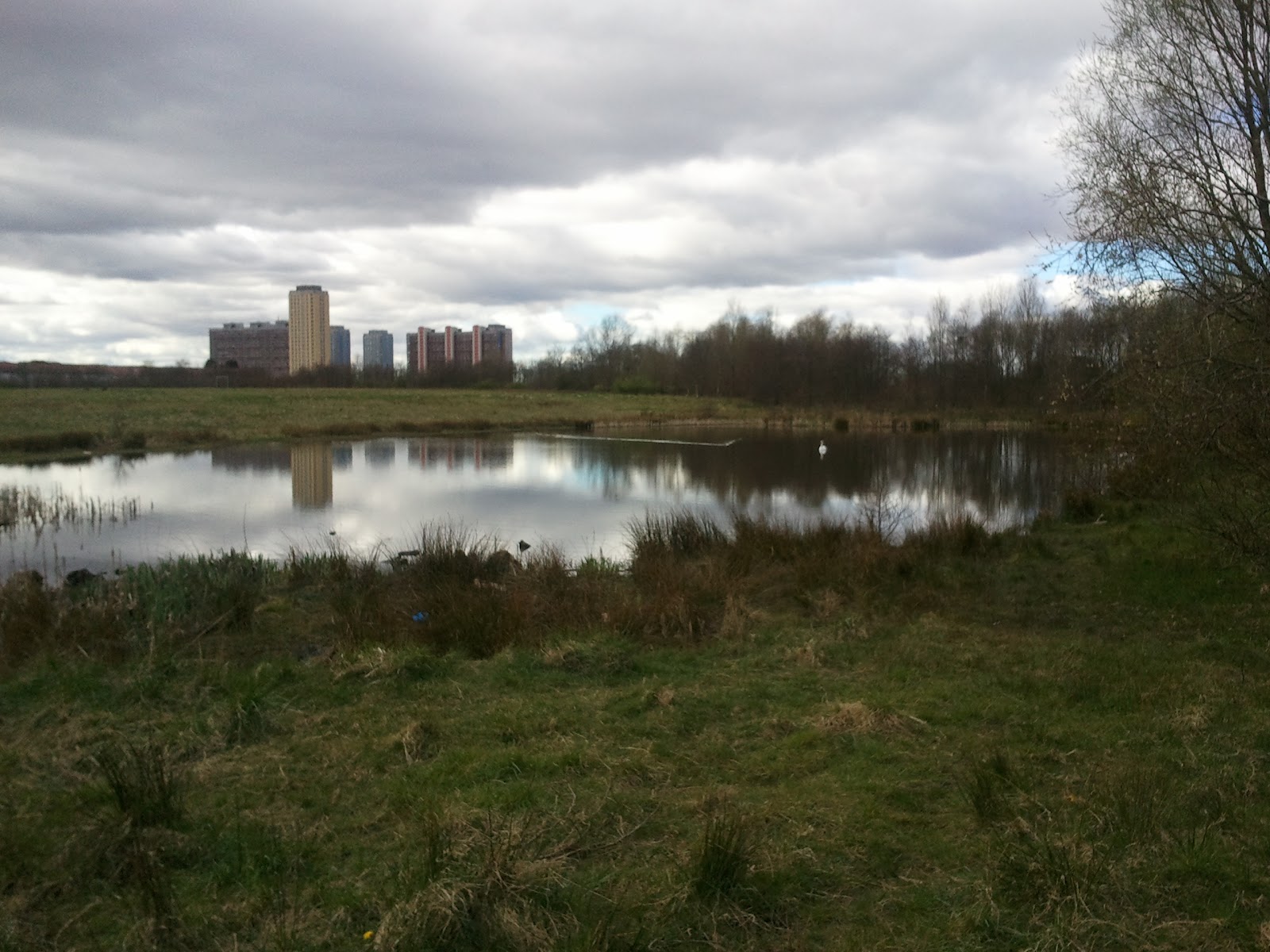
I took this photograph while out on a bike ride with the kids at the end of March this year. I had been thinking about urban biodiversity after reading an article on Nature Deficit Disorder and this view caught my attention. We were in Robroyston Park, one of Glasgow's parks which is designated as a Local Nature Reserve. A diverse range of habitats are present. The pond at centre frame attracts the swans pictured and other birds, insects, fish and amphibians. Particularly striking are the brightly coloured dragon flies (or damsel flies) when in season. To the right of the frame is deciduous woodland providing cover for small mammals and birds, including a heron which nests in the trees and to the left we have rough grassland which is attractive to many insects and various ground nesting birds. Juxtaposed in the background are several blocks of high rise flats - reminding us that we are in the midst of a densely populated urban environment.
For reasons that may become obvious, I returned to the location and took the picture below from around the same spot. Looking at the colour of the sky you could be mistaken for thinking the two photos were taken on the same day. There is more foliage on the trees now than ten weeks ago but can you spot the other significant change in the scene?

Do you see it? If not, here is a clue - look at the buildings. Last Sunday lunch time the first of the Red Road Flats was demolished with a controlled explosion.
The flats have been a prominent feature on Glasgow's skyline for over 40 years, especially when approaching from the east and north east. They have also featured in a book and a film. At their peak, the eight blocks housed 5000 people in an area of only 400m by 200m or 8 hectares. This works out to be about 4-5 times the housing density recently targeted for new housing in order to minimise urban sprawl.
The flats were built to house those living in overcrowded city centre slums, giving families more space and a better standard of living. Unfortunately it didn't work out as planned and residents felt an increasing sense of isolation, less feeling of community and fewer local amenities. Public transport connections to other parts of the city were poor or non-existent and local amenities were limited in comparison with traditional areas with similar populations. Homes were allocated by lottery resulting in former neighbours being split up, reducing community cohesion from the start. Vertical living on this scale also meant that residents would only meet neighbours on the same floor regularly which again differs from more traditional urban environments. This isolation combined with other factors such as high unemployment, alcohol abuse and, later, drug dependence all contributed to the poor reputation of the flats which, in turn, drove out those who could leave. Over the years there have been attempts to fix the problems with little success. This is not an isolated case: similar issues are apparent in many of Britain's former industrial cities.
As the world's population continues to grow and more than half of us live in cities, we need to find ways to be comfortable with living closer together. If cities continue to expand in a low rise urban sprawl we will lose more productive agricultural land and, consequentially, wild land. I don't think anything in this scale will be attempted again, at least not here, but we can't all live in detached villas with large gardens.
And so, the city evolves, as does nature, and with time the last marks of civilisation will be erased from this view because the new houses are all hidden behind the trees.
First Published June 2012.
Edited June 2026.
Comments
Post a Comment